


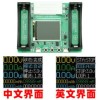
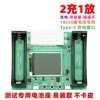
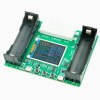
Why buy from us?
Lorem Ipsum is simply dummy text of the printing and typesetting industry.
Ask a Question About This Product
- Stock: In Stock
- Brand: OEM
- Model: RLMIG1013
- Location: https://detail.1688.com/offer/854486293127.html


Instructions Before Use
- Damaged or leaking batteries cannot be tested
- The positive and negative poles of the battery must be oriented correctly during testing
- The charging chip is a 4056 charging chip specifically designed for ternary lithium batteries and does not support charging lithium iron phosphate batteries
- The product does not include an adapter. Please use a high-quality 5V charger for power supply. Poor quality chargers will increase the risk of high-voltage breakdown of the chip
- The discharge cement resistor is compatible with the program algorithm and does not support adding, reducing, or replacing discharge resistors of other specifications
- Heat sinks can be installed on cement resistors or fans can be used to increase heat dissipation
- When using Test ② or welding extension cords for testing, the extension cords will increase the line resistance. The internal resistance test values of the DC two-wire method are not of reference significance. As the extension cords increase, the power drop and line loss become significant, which can lead to premature termination of charging and discharging. Try not to use extension cords for testing. If there is a need for extension testing, it is recommended to use copper wires and reduce the length of extension cords.
Tutorial Catalog
1. Technical parameters
2. Hardware Introduction
3. Interface Introduction
4. Charging electrical parameters (does not support charging lithium iron phosphate batteries)
5. Physical display
6. Usage method
1. Technical parameters
Working voltage: DC5V
Applicable batteries: Suitable for batteries that meet the stopping discharge voltage of 2.5-3.5V, starting from 2.8V and fully charged to 4.2V
Power supply interface: Type-C power supply interface (power supply and power cord provided)
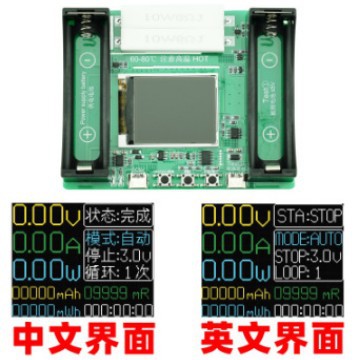
System language: Chinese, English
Number of channels: 1 channel for charging and discharging measurement (the right battery holder is for measurement)
Internal resistance measurement: supported, using DC two-wire method to test internal resistance
Charging function: Supports, automatically cuts off charging when fully charged (does not support charging lithium iron phosphate batteries)
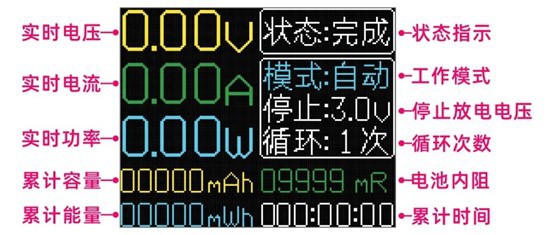
Discharge function: supported, automatically stops when conditions are met, discharge current is not adjustable
Automatic charging and discharging: supported, the battery is fully charged when the automatic mode ends
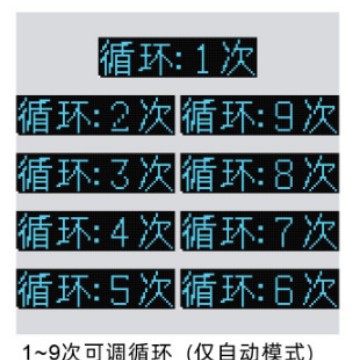
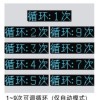
Cycle charging and discharging: supported, adjustable from 1 to 9 cycles (only supported in automatic mode)
Status prompt: Support
Heat dissipation method: natural heat dissipation
Stop discharge voltage: 2.5V, 2.6V, 2.7V, 2.8V, 2.9V, 3.0V, 3.1V, 3.2V, 3.3V, 3.4V, 3.5V, a total of 11 adjustable levels
Discharge current: Maximum of approximately 1A non constant current, non adjustable, and does not support independent modification
Charging voltage: Charging voltage is 4.2V, controlled by 4056 chip. The maximum charging current on the right battery holder is about 1A, and charging stops when the charging current is less than 0.1A.
Power off saving: only saves the set parameters, not the measurement data
Product weight: 110g (including packaging)
Product size: 85 × 108 × 28mm
Packaging size: 153 × 100 × 42mm (corrugated cardboard box)
2、硬件介绍
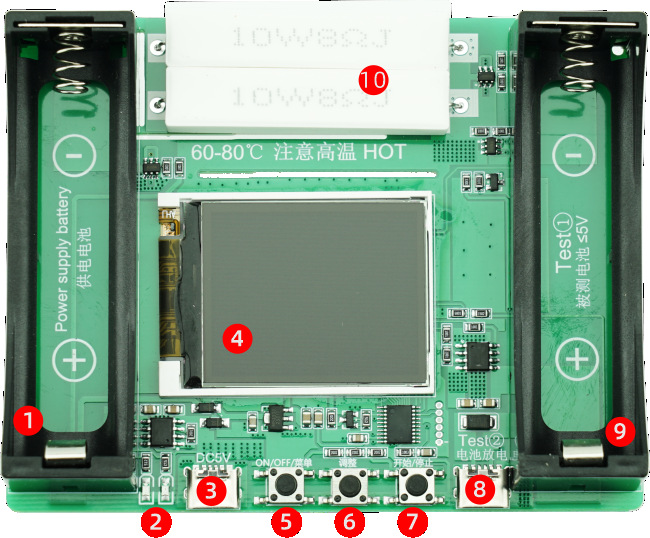
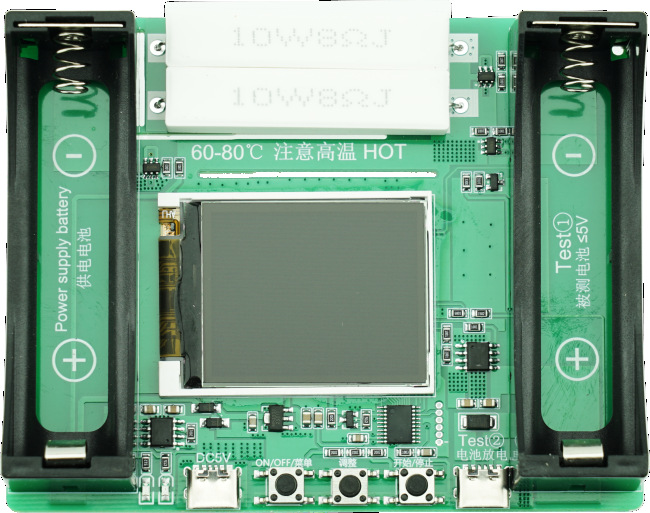
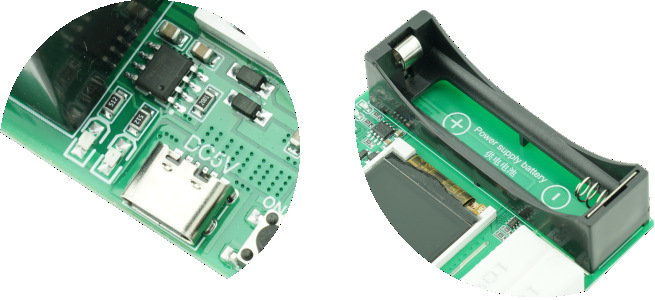
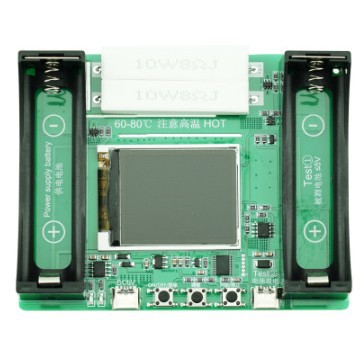
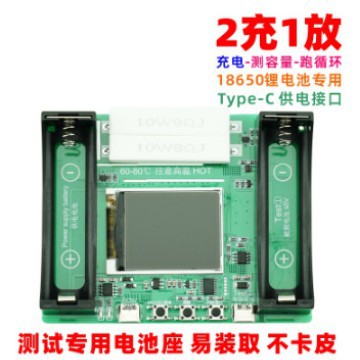
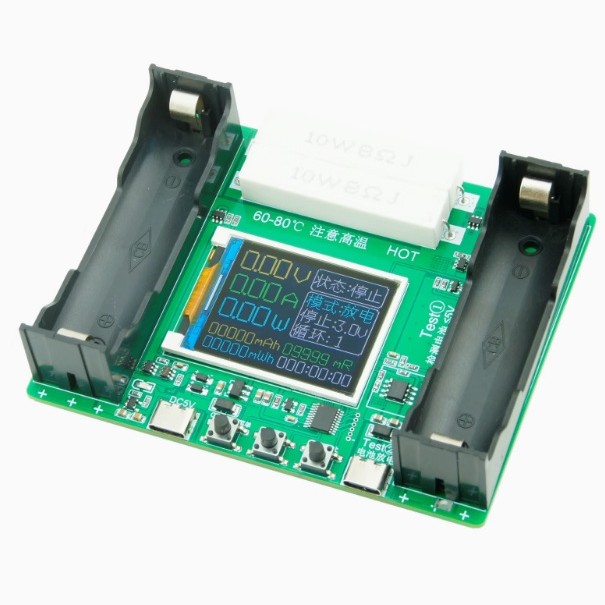
① Power supply battery compartment (not involved in discharge, unrelated to screen display)
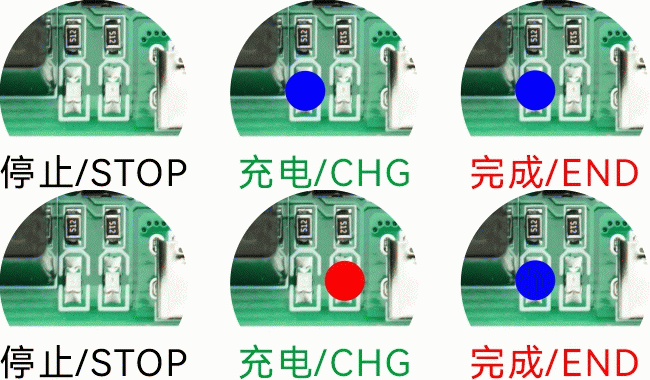
② Blue and red indicator lights: Charging monitoring indicators for the power supply battery, unrelated to the ⑧/⑨ tests
③ Type-C 5V power supply interface
④ 1.77-inch display screen
⑤ ON/OFF/Menu button
⑥ Adjustment button
⑦ Start/Stop button
⑧ Test ② Type-C external discharge interface
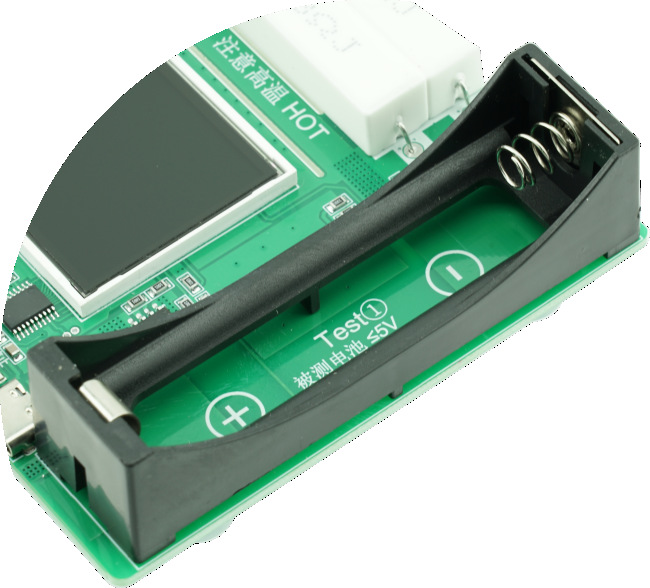
⑨ Test ① Charging and discharging 18650 battery compartment
⑩ 10W 8 Ω J discharge cement resistance x 2
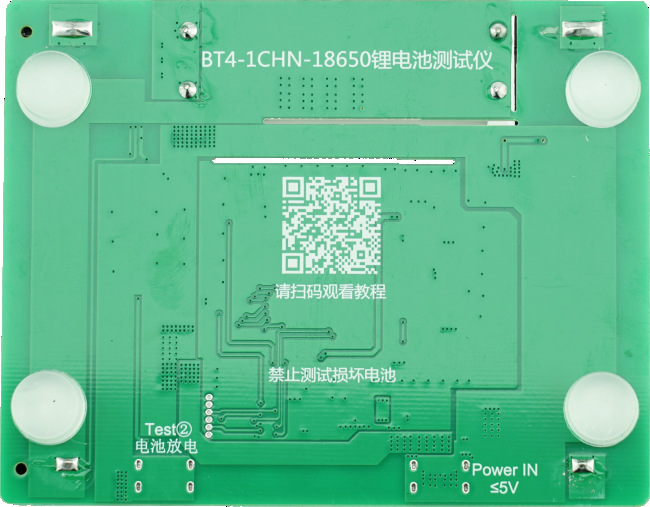
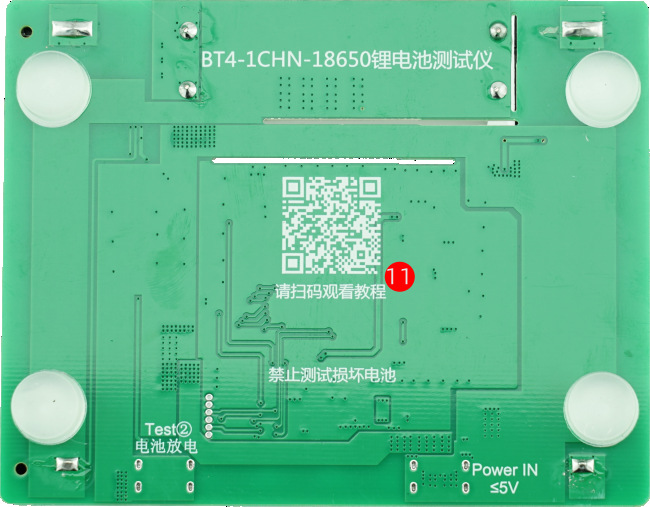
⑪ Scan the QR code to view the electronic tutorial link.
Attention: ⑧ and ⑨ cannot be tested simultaneously
3. Interface Introduction
4. Charging electrical parameters (does not support charging lithium iron phosphate batteries)
symbol | parameter | test conditions | minimum | typical value | maximum | unit |
VCC | Input power supply voltage | four | five | six | V | |
VFLOAT | Output floating charging voltage | 0℃≤TA≤85℃ | four point one five eight | four point two | four point two four two | V |
ITRIKL | trickle charge current | VBAT<VTRIKL,RPROG=1.2K | one hundred | one hundred and twenty | one hundred and fifty | mA |
VTRIKL | Trickle charging threshold voltage | RPROG=1K, VBAT increases | two point eight | two point nine | three | V |
VTRHYS | Trickle charging hysteresis voltage | RPROG=1K | sixty | eighty | one hundred | mV |
When the current is less than 3V, it charges with a small current. When the current is greater than 3V, it charges with a current of about 1A. When the current exceeds 4.2V and does not stop, it is float charging. The charging chip will control the automatic stop of charging. When the charging current is less than 0.1A, it will trigger the stop of charging. After charging is completed, the screen will display 4.1... V, which is a normal situation. If the current is still charging with a large current beyond 4.2V, it should be noted that the charging chip may be abnormal.
5、实物展示